
A Guide To Driving In Mud, Glorious Mud!
Jessica Bird | Thursday 2nd October 2025 10:58am
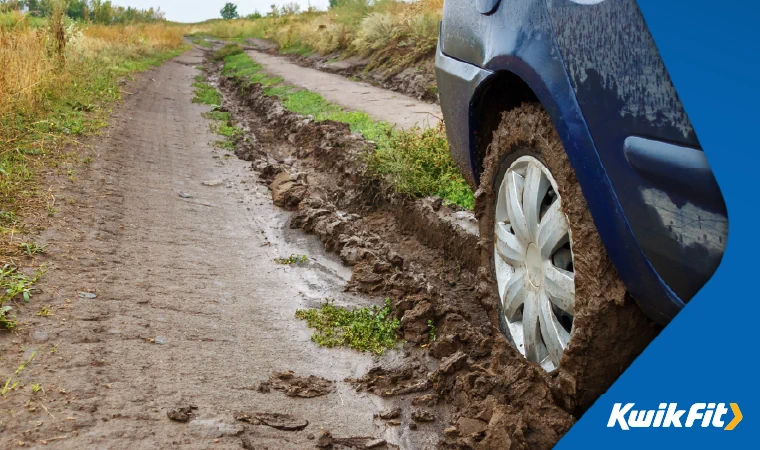
When British weather does what British weather does best, we can always bank on rain keeping our roads and countryside nice and muddy. It’s great for the plants, but not so much for our cars. But as much as the soggy lanes and boggy farm tracks are a pain to have to cut through on a diversion, there’s no denying that they’re simply part and parcel of UK driving – especially through autumn and winter.
And while a splash of mud across your car’s paintwork can be easily washed off, the real problem of muddy roads is that the slippery surfaces often make even familiar roads unpredictable. So we’ve written this guide to handling muddy conditions – because knowing how to safely navigate mud is just as important as knowing how to navigate ice, snow, or heavy rain.
Let’s learn.
Why driving in mud can get sticky (or the opposite!)
Fundamentally, mud is deceptive. It doesn’t always look as slippery as ice, but it can rob your tyres of grip just as quickly. Patches of wet mud on tarmac can send wheels spinning, and rutted country lanes can catch you off guard – especially if you have to squeeze off the road to let another car pass. Add in standing water, hidden potholes, and narrow hedgerows, and you’ve got a driving environment that demands care.
Key challenges of muddy roads include:
- Reduced traction – tyres can lose contact with the road, especially on sharp bends or during braking.
- Uneven surfaces – ruts and ridges can pull your steering unexpectedly.
- Hidden hazards – puddles can conceal potholes, stones, or debris.
- Increased stopping distances – wet, muddy surfaces lengthen braking time.
But why does mud get slippery?
Well, tyre patterns are designed with specific tread depths in order to tackle different scenarios. You can learn all about tyre tread patterns here, but the short of it is that the tread patterns and depths are designed to channel water and other debris away from the tyre, so that the tyre can maintain contact with the road. Mud, being frequently quite sticky, has a tendency to fill up your tyres’ treads and create a perfectly smooth surface – so, in quite a short period of time, you’re left with very little (if any) traction.
If you’re frequently driving in quite muddy conditions, consider investing in a whole set of winter tyres – they tend to feature larger, deeper treads in order to account for mud, rain, and snow.
So driving in mud can be very difficult. But the good news is that, with the right technique, you can navigate mud safely and confidently.
Preparing your car for muddy conditions
However, before you even turn the key, a little preparation does go a long way.
1. Check your tyres
Tyres are your only contact with the road, so grip is everything.
- Make sure tread depth is at least the UK legal minimum of 1.6mm – but for winter and wet driving, more tread is better.
- Inspect for cuts, bulges, or embedded stones.
- Keep tyres inflated to the correct pressure – under-inflation reduces grip in muddy or wet conditions, and increases wear in general. Learn more about tyre pressure here.
2. Keep your lights and number plates clean
Muddy spray quickly coats headlights and number plates, reducing visibility and making you harder to spot. A quick wipe before setting off can make all the difference.
3. Carry the basics
While this isn’t about getting stuck, it’s sensible to have essentials like a pair of sturdy shoes or off-road boots, a torch, and screenwash topped up with a winter-ready solution.
Driving techniques for muddy roads
So, you’re on the road and you spot those tell-tale muddy tracks. Here’s how to handle them.
Steady wins the race
The golden rule for muddy driving is smooth, steady progress. Avoid harsh braking or sudden acceleration; both can cause wheels to spin and lose grip.
Choose your line
If the road surface is covered in mud, look for the firmest track. Often, this means sticking to the shallow ruts where other vehicles have passed. Avoid driving too close to the verge, where mud is likely to be deepest.
Keep your distance
On muddy roads, stopping distances increase. Leave extra space between you and the vehicle ahead to allow for safe braking.
Watch your speed
Even if the national speed limit applies, conditions may mean it’s safer and more sensible to drive much slower. Take bends gently, and expect grip to suddenly change, so that you don’t get complacent.
Tackling country lanes and rural routes
Many of us encounter mud most often in the countryside – whether on a weekend walk, the school run through village lanes, or visiting family in rural areas.
Here are a few countryside-specific tips:
- Expect farm traffic: Tractors often leave mud trails across the road. Be cautious when approaching muddy patches after a junction or field entrance.
- Anticipate blind corners: Narrow lanes can mean oncoming traffic appears suddenly. Drive at a speed that allows you to stop safely if you meet another car in a muddy stretch.
- Use passing places carefully: Some passing places may be more mud than tarmac. Approach slowly, and avoid pulling over too far onto verges where your wheels may sink.
When mud's compounded with other weather
In an ideal world, we’d only ever be approaching mud as just mud – but UK weather rarely gives us just one hazard at a time. Mud often comes hand-in-hand with rain, fog, or icy mornings.
In mud and rain, watch for run-off from fields washing across the road. Treat it as you would standing water, slowing down and keeping a light grip on the wheel.
In mud and ice, frozen mud can create unpredictable, uneven surfaces. Drive with extreme caution, especially early in the morning before the nighttime frosts have had a chance to thaw.
In mud and fog, dirty spray from other vehicles can quickly coat your windscreen. Keep washers topped up and use dipped headlights.
Cleaning up up after muddy journeys
While mud is easy to clean off, it’s important that you actually do clean it, because mud doesn’t just affect how your car drives – it can also damage it over time. Here are some key ways it does so.
- Underbody build-up: Mud stuck underneath can trap moisture, encouraging rust. A quick rinse with a hose helps keep your car in good condition.
- Wheel arches: Packed mud can affect steering and braking components.
- Visibility: Windscreens, mirrors, and sensors (including parking aids) need regular cleaning.
Consider scheduling a professional car service if you regularly drive through muddy conditions. Our technicians check brakes, suspension, underbody, and a whole host of other components so that you can have complete peace of mind.
Avoid getting stuck
This guide is all about avoiding problems with mud in the first place. But if you do ever find yourself stuck in the mud, check out our dedicated guide on getting unstuck.
With good prep, muddy roads don't have to be a nightmare
While driving in the UK means mud is an inevitable part of the journey (regardless of whether you’re commuting to work down country backroads or taking the family on a weekend adventure), it doesn’t have to be a journey-cancelling nightmare.
With a bit of caution and some prep, you’re sure to be able to handle any road – but make sure that your car’s up to scratch, too. Opting for regular MOTs and servicing at your local Kwik Fit centre makes sure that your tyres, brakes, suspension, and everything else is always in the best condition to handle anything that our roads throw.
Find your nearest Kwik Fit centre here.


Any facts, figures and prices shown in our blog articles are correct at time of publication.
Featured Articles
Is it Illegal to Drive With One Headlight?
Saturday 19th July 2025

Wondering if it’s illegal to drive with one headlight? Learn about the safety risks and penalties of illegal blown bulbs and why you should fix them promptly.
Air Con in EVs & Hybrids: Experts Answer Your Questions
Monday 30th June 2025

Does air con drain EV batteries? Can you use the air con while charging an electric car? Find out the answers to these questions & more from Kwik Fit’s experts.
Why Is Your Car Making a Noise? Fixes & Tips
Friday 13th June 2025

When your car starts making unexpected noises, it can certainly be quite disconcerting; it may be nothing to worry about, but here’s what you need to know.